Showing posts with label Re-releases. Show all posts

Sunday, 4 June 2017

Manhattan - Review

Woody Allen's gorgeous paean to Manhattan, Manhattan, is back in cinemas looking even more gorgeous than ever thanks to a digital restoration. Oh what a wonderful time to be alive. 


Near the end of Manhattan, the embittered, neurotic writer Isaac (who could have guessed he'd be played by Allen) records an idea for a short story where he stutteringly tells us, "... about people in Manhattan who are constantly creating these real unnecessary neurotic problems for themselves because it keeps them from dealing with more unsolvable, terrifying problems about the universe". With this somewhat postmodern flourish, Allen sums up pretty succinctly the tale of human folly that comes to pass in Manhattan (and I guess quite a few Woody Allen films).

The film centres on Isaac, a Marcello in La Dolce Vita or more recently Jep in La Grande Belleza style character, who experiences a mid-life crisis of sorts, coming to the realisation that the creative intellectuals with which he has surrounded himself are just as clueless and lost as we all are. With a healthy serving of two of Allen's favourite themes, existential angst and self loathing, we see him hop between relationships with two women who are in many ways, polar opposites of each other. There is the 17 year old Tracy, played with remarkable honesty by Mariel Hemingway, who despite her age shows the most emotional maturity of any of the characters and Diane Keaton's Mary, a charismatic wrecking ball of nervous energy and intellectualism ("it had a marvellous kind of negative capability").  

Manhattan is one of those stupidly quotable films - up there with the likes of Spinal Tap and Life of Brian - just brimming with moments of comic brilliance. I'm not going to list off a pile of my favourite quotes because I would be here for a while but it is worth noting the wonderful Diane Keaton, Woody Allen chemistry that is at the absolute top of its game. Perhaps epitomised by the scene that ends with the iconic shot of them under Queensboro bridge, the two combine so charmingly, each as sharp and involving as the other. They are surely one of the most convincingly compatible on screen duos of all time.

It seems to be the case in most of Woody Allen's really great films that the comedy is underpinned by some unforeseen emotional heft. Manhattan certainly follows this rule; featuring some heartbreaking moments that sneak up on you - the break up with the milkshake, the "Tracy's face" sequence - and a bittersweet ending a lot more than bitter than it is sweet. Most importantly, Manhattan is a film that sticks with you more than you might expect, showing a little of the caustic cynicism that is on full display in the likes of Crimes and misdemeanours, he paints a somewhat bleak picture of human nature.

As well as this, Manhattan has to also go down as some of Allen's most delightfully cinematic work; with Gordon Willis' moody monochrome cinematography and a George Gershwin soundtrack that I have to remind myself wasn't written for this film, the city is elevated to seem larger than life, a thing of unique beauty. This certainly plays as Allen's love letter to the city as much a part of his cinema as anything else. Indeed, the words of Isaac's opening monologue seem autobiographical, "he adored New York City, he idolised it all out of proportion".

Sunday, 21 May 2017

Ali: Fear Eats the Soul - Review

The prolific exponent of New German Cinema Rainer Werner Fassbinder is back on the big screen thanks to a BFI retrospective.


Fassbinder's super low budget reworking of Douglas Sirk's 50's melodrama All That Heaven Allows, is a simple uncluttered film that, perhaps as a product of the lo-fi approach taken by Fassbinder, achieves remarkable clarity. The film tells the tale of an unlikely relationship between a Moroccan immigrant and an older German cleaner whose straightforward, singleminded commitment to one another is summed up nicely by Ali's warning, "much thinking, much crying". This is a film all about them against everyone else; they love one another and that is all that matters.     

Although the two at times seem worlds apart, they are united by one thing: their status as outsiders. Ali doesn't feel at home in Germany for obvious reasons, spending all his time in a bar with other Arabs, he feels undervalued by German society. To put it his way, "German masters, Arab dogs". The xenophobia directed towards Emmi is less overt but also present; her Polish surname "Kurowski" leads to questioning of her legitimacy as a "proper German". Fassbinder is well equipped to deal with these themes of isolation and discrimination as a man who was always an outsider in some way. Here, he treats his characters with brutal honesty, capturing something of the very human yearning for companionship.

Throughout the film, Fassbinder uses visuals adeptly to emphasise the changing dynamics of Emmi and Ali's relationship. In their first encounter in a bar, the manifest sociopolitical boundaries that separate them are highlighted by the physical distance that Fassbinder places between the characters when he positions Ali at the far end of the bar. Later, when they are in Emmi's small apartment, we see them almost huddled around the table, captured in an intimate domestic light. Fassbinder also often alternates close involved shots of the two with long ones of onlooking strangers, illustrating their exclusion from the rest of society. 

Also worthy of considerable praise are the central performances of Brigitte Mira and El Hedi ben Salem whose apparent discomfort in their own skin fosters a delightfully awkward chemistry. Emmi is painfully aware of her old age, running her fingers across her wrinkled face when looking at her reflection in one particularly raw sequence, she is convincing as a woman who had almost given up on love. Ali seems similarly uncomfortable, but for different reasons; throughout the film, he looks stiff and out of place, never seeming at ease with his surroundings in a manner apt for a man who hasn't been accepted as a part of Germany. 

In Fear Eats the Soul, Fassbinder does something not often done right: create a polemic with pathos, as scathingly political as it is tenderly romantic. It is a film about the all-consuming courage that love can inspire, imbued with a fiercely brazen anti-xenophobic message. The titular words of Ali, "Fear eats the soul", make for a very fitting title; it is both a reflection of the fearlessness of the lovers and a warning against the erosive influence of bigotry.

Wednesday, 3 May 2017

Mulholland Drive - Review

Mulholland Dr. has been re-released in a shiny new 4K restoration. I took the opportunity to see it on the big screen, in all its cinematic glory.


Mulholland Drive, what many would consider to be David Lynch's pièce de résistance, is Lynch at absolutely peak Lynch; caked in the nightmarish intrigue in which he specialises, it is a truly bizarre exploration of the dark labyrinthine world, hidden beneath the glamour of Hollywood. As we are plunged deep into this surreal dreamscape version of LA, he twists us this way and that, ultimately leaving us with an undeniably potent enigma of a film, as compelling as it is disorienting. 

Perhaps the most brazenly unconventional choice of all the brazenly unconventional choices in Mulholland Drive is the way Lynch plays with narrative. The film's plot does not make sense in any traditional sense of a plot making sense. As the film progresses, there are a number of scenes that are left to drift without the resolution one would expect and if they didn't have you confused, the later sections are packed with obvious contradictions that are sure to complete the job. However, the plot is not just one big mess. In fact, Lynch toys very deliberately with the expectations of the audience - using Heat-esque cityscapes to establish a somewhat noirish setting, he hints at a resolution that never materialises - leaving various strands of the story lingering enigmatically, ready to be untangled, before tangling them further. By deftly alluding to unforeseen connections in the later portion of the film - a blue key, a name tag, a man looking scared - we are made to feel lost, grasping at some answer that lies just beyond our reach.        

Beyond the obviously eye-catching plot, there is much more to be enjoyed (not that the plot is terribly enjoyable to be involved with), namely, Lynch's impressive aptitude for the creation of unease and tension. Throughout the film, he blurs the line between reality and dreams; by playing with the fears that lie at the deepest corners of our thoughts, he is able to lace unexpected moments with an atmosphere of unquantifiable disquiet. This is perhaps exemplified best by one of my favourite scenes where we are introduced to two men in a diner. When their conversation turns from the mundane to the more macabre, the monotonous rumbling of Angelo Badalamenti's score and a quietly wandering camera are coupled to chilling effect, warning us of some peripheral threat. It's moments such as this that Mulholland Drive is at its disconcerting best.

Also notable are the two leads who both give performances more nuanced than the surface may suggest. Laura Harring is the amnesiac Rita/Camilla Rhodes and Naomi Watts is the small town Hollywood hopeful cliché Betty/Diane Selwyn (the plot is such that it's hard to give any definitive names), who descend into an increasingly odd Persona style relationship when they stumble across each other. Harring is Liv Ullmann in the analogy, full of a similar languidly beguiling charm, her initial facade of innocence is replaced by a pleasingly sinister confidence as the film progresses. The Persona comparison also works pretty well with Watts and Bibi Andersson whose warm-hearted perkiness is once again turned on its head in the final scenes, when her aspirations of stardom seem to crumble.

Above all though, Mulholland Drive works as an evocation of the shadowy underside of Hollywood, all faded glory, forgotten dreams, and lurking menace, Lynch provides a commentary on the perhaps corrosive influence of Hollywood with the uniquely unsettling style that only he could. This tone is epitomised by the strangely captivating "Club Silencio" scene; as the presenter flourishes his hand and we get a close up of his intense features, he cries "It is... an illusion!", words that in the moment are deeply impactful but whose meaning on further reflection, is a mystery to me. This is what is exciting about Mulholland Drive, it is a film that sweeps you up, appealing directly to your emotions not logic, every inexplicably heady moment feels viscerally involving.

Wednesday, 22 March 2017

GoodFellas - Review

I'm back with another Scorsese classic, this time it's his sprawling crime epic GoodFellas.

Related image


GoodFellas is a film that shows an auteur at the peak of his powers - directed with the swagger of the wiseguys that our protagonist Henry Hill idolises - Scorsese invites us into their world. From the famous freeze frames, now synonymous with Scorsese, to the elegant long takes, he isn't afraid to let us know that he is there; showing considerable directorial flare, he paints a stylish picture of the milieu of the wiseguys, bathing us in every unique detail. Indeed, like many great gangster films, GoodFellas surrounds you completely with their lifestlye, blurring the lines of morality, implicating us in the crimes that are committed. As a result of the odd hermetically sealed bubble in which the story takes place, we are made to understand the distorted morals of the characters; when Henry's wife Karen narrates, "After a while, it got to be normal. None of it seemed like crimes.", we can empathise with her feeling. 

One thing instantly remarkable about the film is that it lacks any clear central narrative drive; instead, it is more of a collection of short detailed stories, parables even, that come together to form an idea of the story of the wiseguys. Scorsese is more concerned with capturing the overarching mood that surrounds their lives, using this loose yet precise method of storytelling to cover a broad range of time whilst maintaining an intimacy with the main characters. He shows us their life in its entirety. From the almost quixotic ambition of the early years to the inevitable decay that follows, every stage of their rise and fall is rendered completely convincingly. 

Scorsese uses the long take brilliantly to capture the initial allure of the life of the gangster. During the famous "Copacabana" sequence, Scorsese's choice for Henry and Karen to go in through the back door is inspired, it distills perfectly what attracted Henry to being a wiseguy. Whilst displaying Henry's influence, the long take also echoes the atmosphere of hectic excitement; as the camera weaves its way in and out of the waiters, its swift movements are overwhelming, placing us in the shoes of Karen. We also have the perhaps underrated introduction scene where one glorious long take plunges us into the dingy depths of the "Bamboo Lounge". Henry's introductions to the likes of "Pete the Killer" and "Jimmy Two Times" are handled with a knowingly comic edge, highlighting the ridiculousness of this friendly family of criminals.

In fact, GoodFellas is a film laced with surprisingly frequent moments of caustically dark comedy. These serve to draw attention to the hypocrisy of the combination of their unsavoury work and the respectable family life that they hold so dear. When they stop at Tommy DeVito's (another gangster) house mid-killing and his mother (played by Scorsese's mother) insists that she cooks for them, the innocent domesticity of the sequence is made to seem completely comical. As Tommy compliments one of his mother's paintings "I like this one, one dog goes one way, one goes the other", Scorsese does the same thing that the montage at the end of The Godfather does, albeit in a rather more understated manner. 

Despite the at times affectionate treatment of the gangsters, the film ultimately exposes the fickle, egotistical motives that drive everything they do. Near the start of the film, a young Henry is lectured on the importance of loyalty by local gangster Jimmy Conway, "Never rat on your friends and always keep your mouth shut!". By the end of the film, the list of friends Jimmy has "whacked" is considerable, and the people Henry dedicated his life to have turned on him. The deceit central to their lives is summed up in heartbreakingly pragmatic fashion when he describes the process he has seen so many times, "Your murderers come with smiles. They come as your friends, the people who have cared for you all your life, and they always come at a time when you are at your weakest and most in need of their help."

GoodFellas, like all of Scorsese's best work, is unflinching in its portrayal of its main characters. Here, Scorsese is completely unafraid to end on an unhappy note, coming out with a final act that is brilliantly bleak in its depiction of the paranoid turmoil that Henry's life has devolved into. As we follow his manic movements on the day he is finally caught, we see a man living a life completely devoid of any of the allure that initially enticed him to the life of the wiseguys, swamped by the mundane juggling act he is failing miserably to execute. When all is said and done, Henry is consigned to a fate that is worse than death in his eyes, he has to live life like everyone else does. As Henry puts it, "I'm an average nobody. I get to live the rest of my life like a schnook".  

Wednesday, 15 March 2017

Taxi Driver - Review

Thanks to the BFI's Scorsese retrospective, a digital restoration of the classic Taxi Driver is showing all over the place.


Related image


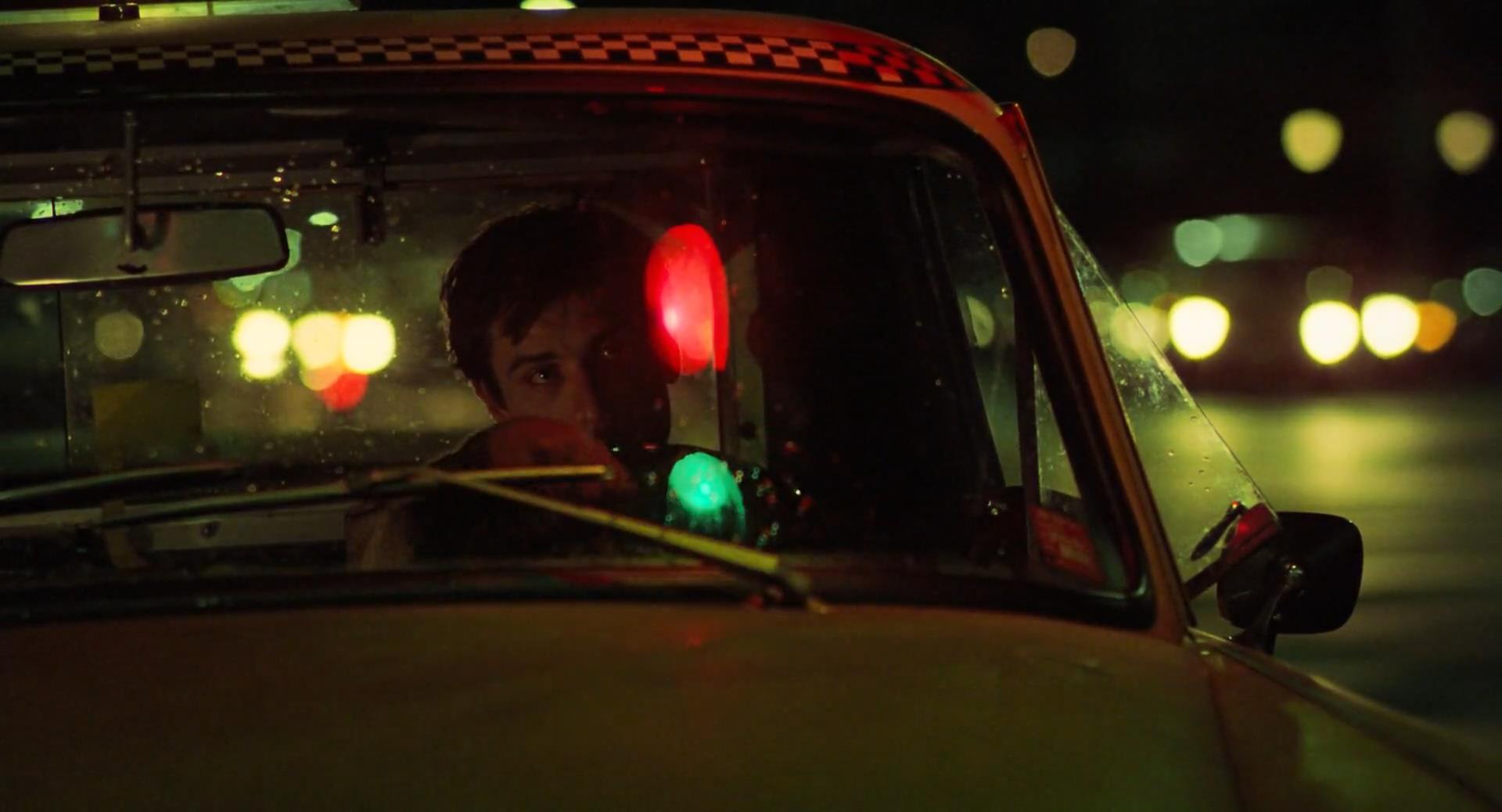
We open on Travis Bickle's dark watchful eyes gazing out of the window of his cab; he sees dreamlike scenes, all billowing smoke and blurred neon lights. Every distorted image is viewed through the lens of a windscreen that gushes with water - an apt division to place between our protagonist and the world - it echoes both his detachment and clouded perspective. This opening passage through what seems a sort of Stygian underworld is rendered with an achingly cinematic style that continues throughout the film. Michael Chapman's cinematography captures the clashes of the dark street corners with harsh artificial shop signs, bleeding them into one another, whilst the saxophone of Bernard Herrmann's score expresses something completely transcendent.     

Travis is perhaps the defining example of the type of fundamentally flawed character with which Scorsese and De Niro worked so brilliantly in the late seventies and early eighties. From Travis Bickle to Jake La Motta all the way to Rupert Pupkin, they showed themselves to be masters of the portrayal of emotionally crippled men, deeply isolated from the world. In Travis' case, this manifests itself as an irrepressible desire to salvage what innocence he can from a world that he perceives as rotten to the core. 

Despite this morally ambiguous centre, Travis is treated typically affectionately by Scorsese, fostering - in the same way that he often does - a compassion for a character that is profoundly flawed. Indeed it is the ways in which these flaws are explored which make Travis so completely likeable; we are able to empathise with everything he does on some level. Even more instrumental in this is De Niro, brimming with wiry energy, his performance paints a picture of a man at tipping point perfectly. When he says "I get some real crazy ideas, you know?", we definitely believe him. However, what is most compelling about his performance is the visible evolution of the character. The descent from his burgundy blazer clad charm to the gun toting vigilantism with which we finish is made completely convincing by De Niro.    

As the film gradually progresses towards a violent climax that feels inevitable, the growing sense of grim direction we see in Travis is mirrored by the film. We are made to feel like him - careering towards the edge of a cliff - without the means or desire to divert our course. One excellent sequence shows Travis watching the TV, he sits back in an armchair tipping the crate on which it rests with his foot, pushing it farther and farther until finally it crashes to the floor, breaking the TV.  Moments such as this epitomise the subtle ways in which Scorsese foreshadows the destruction that is to come; the TV seems a fitting representation of both his precarious mental state and the self destructive compulsion central to his character.

When we finally reach the climax, Scorsese does not disappoint, putting together one of the most uncompromisingly grim sequences in cinema history. Travis tears through what becomes a blood-soaked brothel with deranged determination; we see a man possessed, feeling the visceral intensity of every gunshot. When the dust settles, Travis slumps onto a sofa, does the famous finger gun to the head and stares skyward; no words are needed. Scorsese cuts to a shot from above that looks down on the aftermath - as it quietly surveys the carnage with odd serenity - it seems to both lament and condemn what has happened.

Following this is the much debated ending, depicting a world where Travis has been hailed as a hero for what he did. Is it another manifestation of Scorsese's compassionate treatment of his main characters? An ironic flourish, hinting at Travis' continued mental instability? Who knows (I fall into the Travis' fantasy camp). Above all else though Taxi Driver works as a tale of social alienation - an unflinchingly brutal study of one man's search to connect with a world that seems completely foreign to him - the film expresses a profound loneliness that is universal. As Roger Ebert pointed out, it is the "well I'm the only one here." that follows the famous "Are you talkin' to me" that really cuts to the heart of Taxi Driver.

Sunday, 5 February 2017

Solaris - Review

All seven of Tarkovsky's films have recently been re-released in the Sculpting Time retrospective. I took the chance to see go and see his third feature, Solaris.


Tarkovsky's take on science-fiction, tells the tale of psychologist Kris Kelvin (Donatas Banionis) as he travels to a space station to investigate reports of strange goings on. The film opens with images of his garden, capturing the plants in a magical light which establishes a detached, transcendent visual style, maintained throughout the film. Cuts are infrequent as languid camera movements lend a sense of importance to each shot; this slow pace invites us to consider every image in extreme detail, giving the film a contemplative atmosphere.

After discussion with an ex-pilot who claims the star system had supernatural effects on his mind, Kelvin makes his way to the space station. On first arrival, we enter a particularly gripping portion of the film, as Kelvin is confronted with bizarre hallucinations, he starts to question his sanity. The ambiguity which permeates the whole atmosphere creates a tension that is only added to by the precise passivity of Tarkovsky's visuals. Some light is shed when Kelvin meets the other scientists on the station and his descriptions of hallucinations are met with knowing looks of resignation.

As the film continues we come to understand that the star system is able to play with the consciousness of the inhabitants of the station, creating "guests", physical manifestations of the memories the inhabitants. Kelvin sees Hari (Natalya Bondarchuk), a girl he once loved before she commited suicide. It is the relationship that progresses between them that is the heart of the film; as Kelvin comes to love her once again, philosophical questions about the nature of love and perception are posed. Hari has been given self understanding and free will by the star system that gives her the capacity to realise that she isn't the same person that once knew Kelvin. Both of them are distressed by the disconnect between their emotions, giving the film a sorrowful tone as they realise the hopelessness of their relationship.

Comparisons have often been made between this film and Kubrick's 2001. It is true that there are many similarities: reflections on the nature of alien life, a challenging lack of narrative drive, and a captivating visual style. Despite this, I believe the central philosophy of the two films is vastly different. In Solaris, the alien intervention causes introspection and an analysis of human nature, however, in 2001, contemplation of a cosmic scale is caused, as our place in the universe is questioned.   

Of course, there are moments that the glacial pace of the film grates. Some sequences of monologue featuring philosophical ruminations on the role of science near the end of the film lost my attention. However, in many ways, the beauty of the film lies in the slow pace; as a result of the distant meditative approach, a sense of enigmatic grandeur is achieved which would not have been possible in an hour and a half. Few directors would have had the audacity to even attempt a film this unconventional, but through this invention Tarkovsky creates something unique, a quality that should always be appreciated.